

JOIN JANE CONTINUING TO MAKE SENSE OF ART
And this month Jane is learning about Columns.
Another month and some more travel! I have recently come back from a trip to Jordan, where having visited the ancient sites of Jaresh and Petra I was struck by how little I knew about ‘columns’ – the architectural invention that made it possible to support a ceiling, without having to build solid walls. I saw hundreds if not thousands of columns and was taken by the many different styles and how ornate the stone carving was.
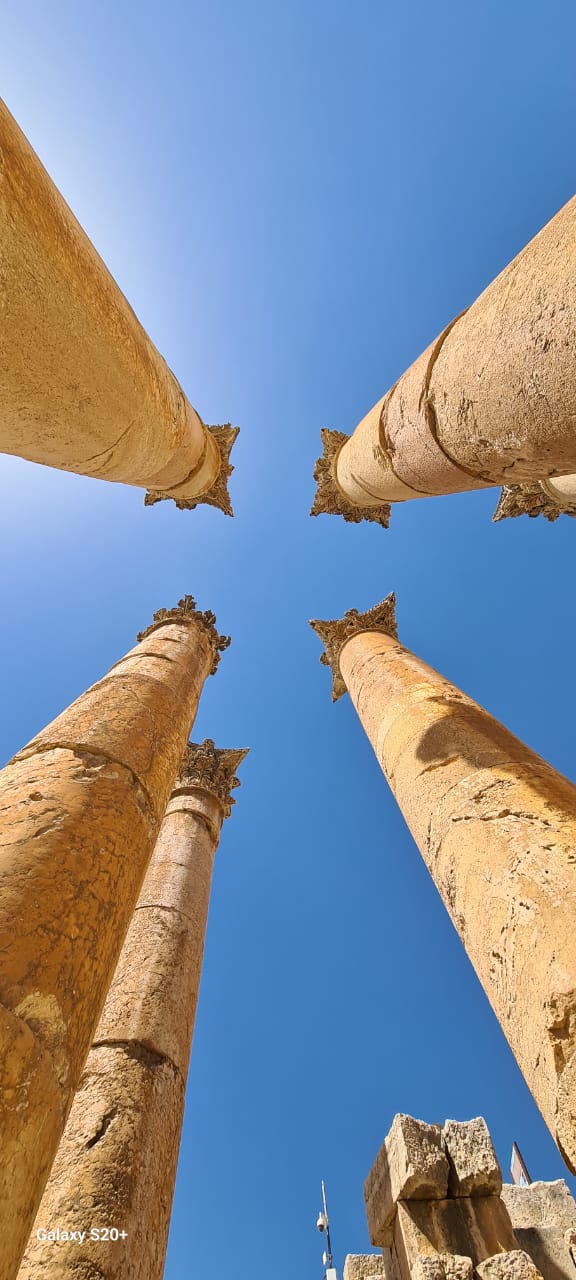
So – in a nutshell, there are 5 different styles of columns;
1. The ‘Doric’ is the simplest column – plain and sturdy with a fluted column. The top bit which is called the ‘capital’ was unadorned – just flat. I didn’t notice any of these on my travels.
2. The ‘Ionic’ is defined by its ‘Volutes’ at the top. These are the scroll like patterns. I saw many of these. Some were quite plain scrolls, others were quite ornate.

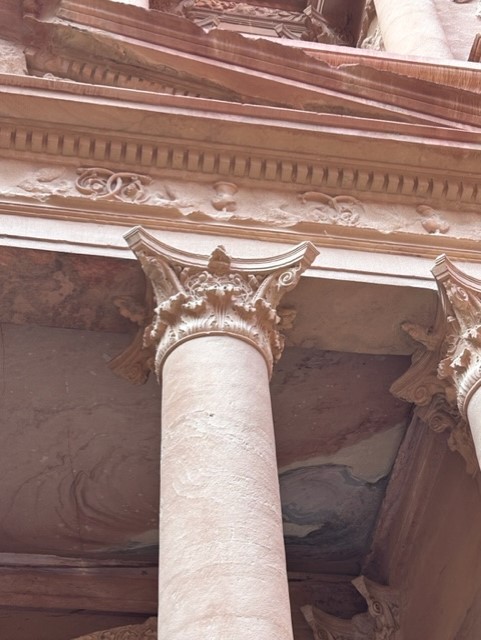
3. The ‘Corinthian’ is the most ornate column. It has a decorative, bell-shaped capital with volutes, then two rows of acanthus leaves and an elaborate cornice. These were often fluted.


These first 3 styles were developed by the Ancient Greeks and then used by the Romans. Later came 4. The ‘Tuscan’- very similar to the Doric, a very plain unadorned column – not even fluted! The final style is, 5. The ‘Composite’. These were usually more delicate looking columns. The capitals were a mix of Ionic volutes and Corinthian acanthus leaves.
So both Jaresh and Petra were abundant in examples of Doric and Corinthian columns.
Jaresh is one of the largest and best preserved Greco – Roman settlements in the world with much still to be excavated. The highlights were the Corinthian columns of the Temple of Artemis, the oval colonnade of the enormous Forum and Hadrian’s Arch (he of Hadrian’s Wall fame!).

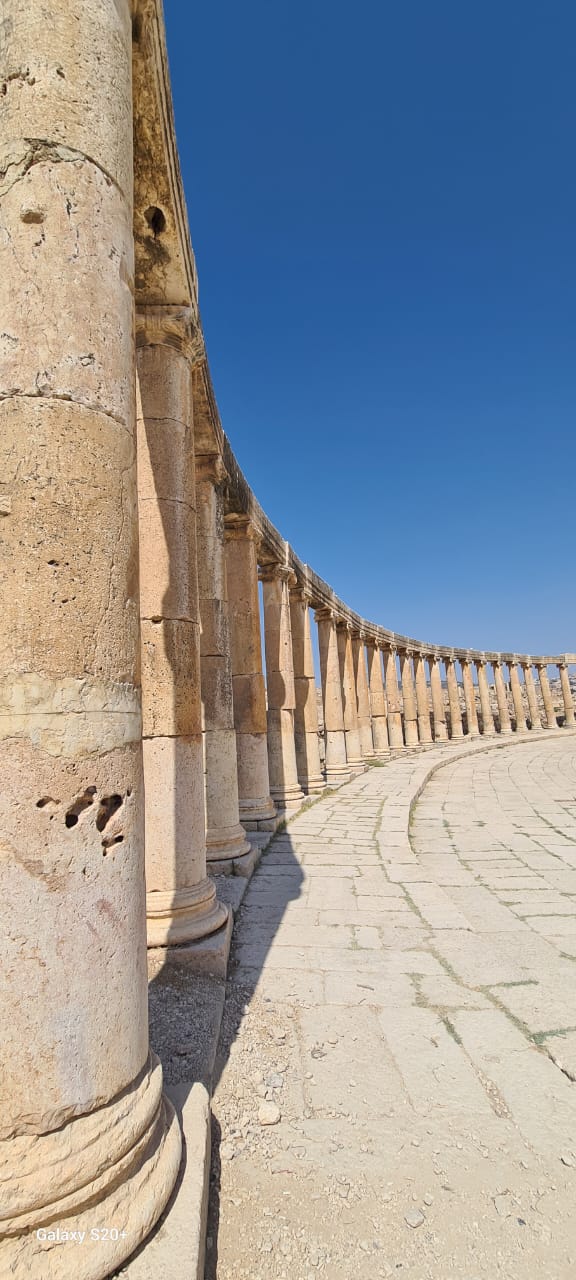
The Bible mentions that Jesus travelled through Jaresh where he performed a miraculous exorcism on a man possessed by demons! It was easy to picture the scene. Walking around the site was a very humbling experience – constantly surrounded by columns of various heights (the higher the columns, the more important the tomb or temple) – but all very tall and one can only imagine the weight! It was interesting to see the grooves in the stone which enabled the builders to attach the column to the ropes/winch system they had for erecting the columns – the first crane! Lying around on the ground were substantial bits of columns and cornices that have fallen during earthquakes over the years. It was wonderful to be able to see the stone masonry skills close up.

Petra dates back to 300 BC when it was the capital of the Nabatean Kingdom. The Nabateans carved into the very beautiful pink sandstone cliffs creating tombs and temples. They were defeated by the Romans in 106 AD who put their mark on the architecture of Petra, otherwise know as The Rose City. The Romans were there until 551 AD when a major earthquake made the city uninhabitable – and there it lay hidden from all but a few locals. It was rediscovered by a Swiss traveller, Johann Burkhardt in 1812 and much excavation has been done. However, like Jaresh, there are still many acres under deep sand. Every now and then you can see the tops of columns poking out of the sand – all very tantalising!
The iconic building of The Treasury is the first one you come to after a 1.2km walk through the Siq – the narrow gorge leading to the city. This building was an important tomb – probably belonging to a King. It has a very grand, very well preserved Greek style facade.
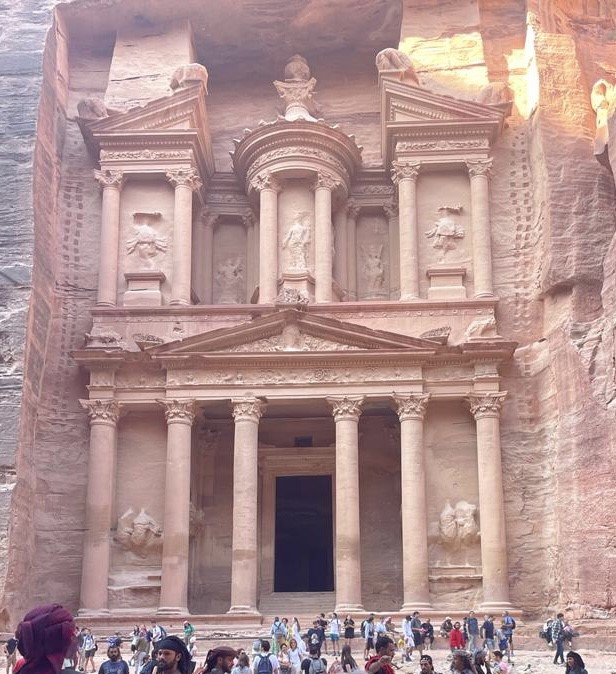
.As you can see below the carved detail is extraordinary not only on the double layer of Corinthian columns but also all over the roof.
The column played such an important part in the construction of many ancient civilisations and we are so lucky that there are still beautiful examples all over the world – it says a lot about the strength of them – those ancient civilisations knew how to build to last! How many modern buildings will still be around in 2000 years?