
JOIN JANE CONTINUING TO MAKE SENSE OF ART
And this month Jane learnt about Portraiture
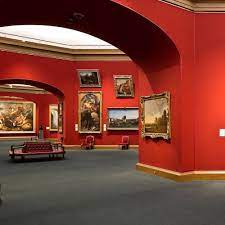
For me, the word “portrait” takes me straight back to my childhood, to rainy days on holiday when the beach option wasn’t going to work so off we’d go to find the closest National Trust House and do the “cultural bit”. I have strong memories of dark floorboards, heavy furniture and the line of family portraits going up the grand staircase. We’d trail up the stairs behind our parents aware of these faces staring at us from large ornate frames as we passed but I never actually looked at them. I knew they must have been former inhabitants of the house and we were there to see how these people had lived – and as children, the fascination was what sort of beds they slept in, how they made their ablutions and how food was prepared. It was a shame that gleaning information from the portraits wasn’t part of this learning process! These portraits were, after all, a precursor to family photographs.
Portraiture is a very old art form, dating back at least 5,000 years. To paint, draw or sculpt was the only way to record the appearance of someone but it became more than just a record. From the earliest times portrait artists had to flatter the sitter – an ‘honest’ portrait artist got little work! People wanted their portrait to show such values as power, importance, virtue, beauty, wealth, taste and intellectual prowess.
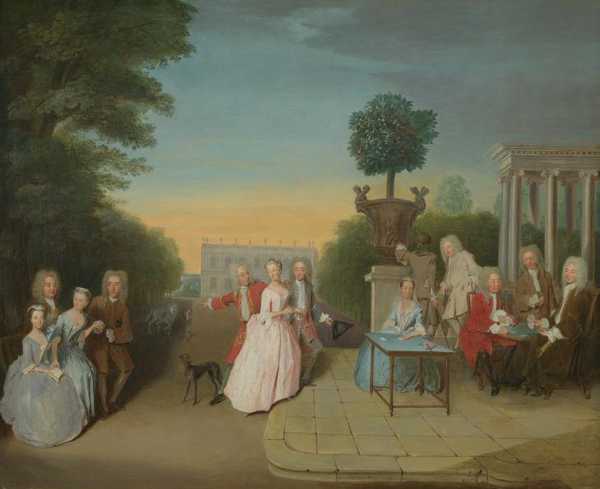
Group portraits, known as “Conversation Pieces” became popular in the 18th Century – a family or group of friends, often in a garden, playing games or taking tea – this was then thought to be very informal.
The following example is in the Tate and is by Philip Mercier, painted in 1725.
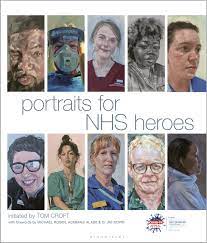
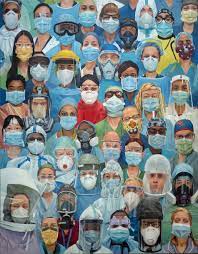
As photography developed, painted and sculpted portraiture declined – with mostly only the rich and famous commissioning new portraits but the art form has not died, in fact recently there seems to have been a bit of a regeneration and there have been some exciting projects – for example “Portraits for NHS Heroes” which resulted in over 14,000 portraits completed during the Covid pandemic www.thenetgallery.com/portraits-for-nhs-heroes/ a project masterminded by Thomas Croft and the Contemporary British Portrait Painters (CBPP) – real everyday people working in difficult circumstances. Not the rich and powerful – the real heroes of today!
I have been thinking about portraiture because of the recent BBC 1 series (still available on Iplayer) Extraordinary Portraits, which I very much enjoyed. It was presented by the Rapper Tinie with the aim to commission portraits that show modern Britain. Each 30-minute episode brings together 2 people – one (the artist) with incredible skill, the other (the sitter) with an incredible story. Tinie introduces the programme saying “Heroes of history with power and or money end up on our gallery walls. I want to find today’s heroes”. His heroes are a burns victim, the twins who fought and survived a crocodile attack, a Nigerian partially sighted model with albinism, the BLM activist who saved the far-right activist, a triple amputee ex-soldier and an 88 year old dairy farmer.
All 6 artists have completely different styles – one photographer, four painters and one pencil artist.
Christy Lee Rogers is an underwater photographer, and she was chosen to create a portrait of Cee Cee, a Nigerian model with Albinism. This was an extraordinary process and quite gruelling for the sitter – or should I say swimmer/floater! The Hawaiian/American photographer creates Baroque style images underwater using swathes of floating fabrics around the subject. It all involved a lot of breath holding for Cee Cee. Christy says that “A portrait should be a message to the world” – the message here was the naked beauty of the subject – underwater, stripped of makeup and wig – not the normal glamour model beauty but the real Cee Cee.
Kelvin Okafor is a hyperreal artist specialising in pencil portraits and his aim in drawing Catrin, a burns victim survivor, was like Christy’s – to show the beauty of Catrin around her scars and using the scars to tell her story. The result was photographic with extraordinary detail and her character shone through. The artist took 650 hours to create this portrait.
My favourite was perhaps the portrait by Roxanna Halls, known as The Mischief Maker. She is a self-taught artist who uses humour and drama in her work. Her studio is a treasure trove of costumes and interesting props, and she refers to her sitters as collaborators and partners in crime. She wants her portraits to capture stories as well as faces and wants the viewer to be able to relate to the subject – be it class, gender, sexuality, experiences etc. Her sitters were the twin girls who fought off a crocodile last year. The story is captured by the two girls holding string puppets of themselves and a crocodile– very much in the style of a Punch and Judy Show – the two girls towering over the puppets like superheroes. Roxanna said that she wanted “to put power back into their hands”. It is a wonderful portrait that cleverly shows the drama of the story and the bravery of the girls but with a humorous twist.
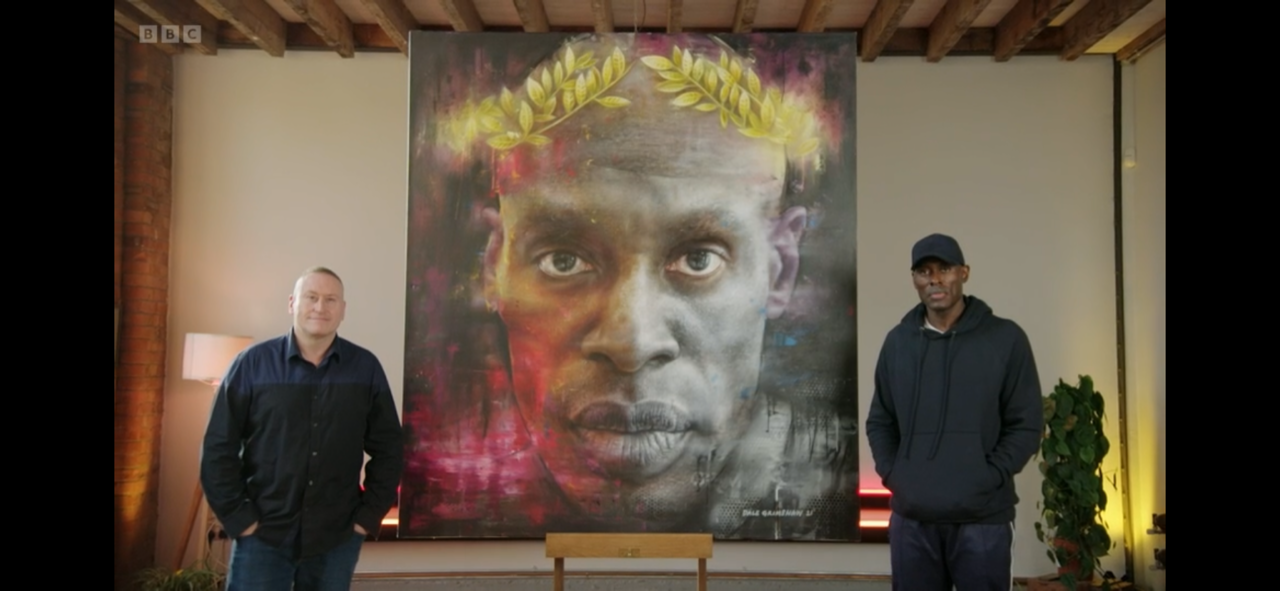
Dale Grimshaw is well known in the field of street art. One of his most famous murals is that of Bob Marley in South London but in his portrait work he likes to mix street art with fine art. He uses very mixed media, including oils, acrylics and spray paint and believes that portraits should not only reflect the current appearance of the sitter but also culture and heritage and should have the power to shock the viewer. Dale’s subject was Patrick who became a viral sensation when he rescued a man in a BLM protest. The result is huge – probably 6 ft square of just Patrick’s head adorned with a Greek style crown of gold leaves in true superhero style. It is almost as hyperreal as the portrait by Kelvin Okafor but in oils and spray paint.
Thomas Croft is a classically trained artist who calls himself “a people watcher and storyteller”. His aim is “to capture someone and preserve them”. Although I said that the Roxanna Halls portrait was my favourite – this also could be because of the family involvement in the painting. The sitter is Mark, a former marine who lost 3 limbs in Afghanistan. Mark’s family are obviously the centre of his life and Thomas acknowledges this by taking the blank canvas to his home and inviting his 2 children to splash colours on to the canvas creating the background of the portrait. The children have complete control over the colours and the effects they create. What I found so interesting and clever was that the artist didn’t just paint over the background, he painted the portrait within the background. Mark’s wife’s reaction was emotional – “that’s my world in that picture” – what better reaction could the artist wish for!
Now, thinking about it, maybe my favourite was the portrait by Caroline Pool! She specialises in the older generation – the older the face, the longer the story! Her challenge was to capture Alec, an 88 year old dairy farmer. She spent several days with him and his family and the surprise result in the “big reveal” was a two-generation portrait – Alec with his farmer son John who runs the farm with him – looking back and looking forward, the certain future of the farm and the family.
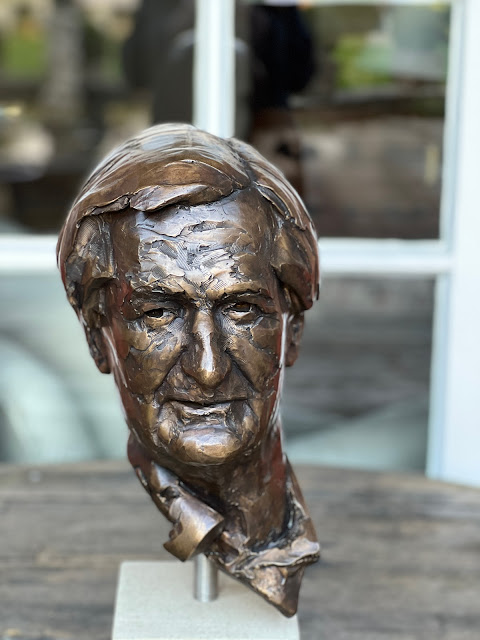
This is a great series – well worth a watch. However, one very fundamental portrait medium was missing – that of sculpture. This is not commonly done today – particularly the traditional bronze bust because it is an expensive thing to do but it shouldn’t be overlooked. A friend of mine recently commissioned Adam Roud to do a bust. Herry said “My desire for a bust of myself arises from the fact that I very much miss not being able to see my father. I would love to see him in the corner of the room, smiling kindly at the world as he invariably did. I reasoned that one day perhaps my children would have similar feelings about not being able to see me.”
Herry looked into a painted portrait but decided that “only in a 3D sculpture can the highest degree of realism be achieved. It’s no surprise that sculpture is finest of the figurative arts.”
Herry was very involved with the process and is delighted with the result – it really is a very true likeness.
Photographs have become our “go to” way of remembering people and events – free and instantly accessible for most of us but we must not forget the power of the portrait artists to capture more than just the moment. The skill to capture the story and the depth of a personality which can be passed from generation to generation is something we should not lose.
Get in contact if you would like help finding the right portrait artist to capture the unsung hero in your life.
Recent Comments